Contents
Access to non-dilutive capital is one of the most significant advantages available to US-based founders in 2026. Federal and state grant programs collectively distribute billions of dollars each year to startups working on technology, research, clean energy, manufacturing, and more. Unlike venture capital, these funds require no equity and impose no board seats. For founders who qualify, they represent one of the most efficient ways to extend runway, validate technology, and build the commercial track record that attracts private investment.
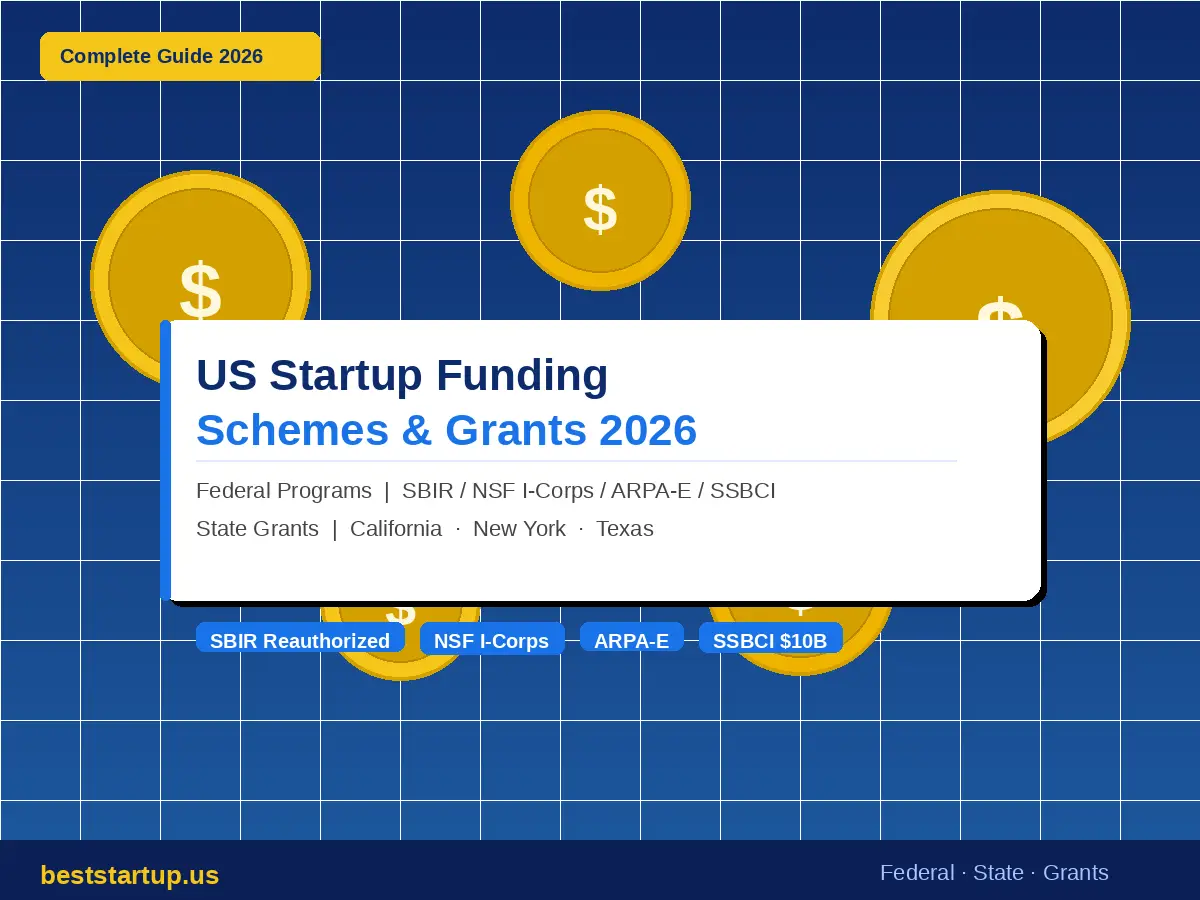
This guide covers the active federal and state funding schemes available to US startups in 2026, including award amounts, eligibility criteria, and application timelines.
SBIR and STTR: The Largest Federal Startup Funding Programs
The Small Business Innovation Research program and the Small Business Technology Transfer program are the largest sources of non-dilutive federal funding available to US startups. Together they distribute more than $4 billion annually across eleven participating federal agencies. On April 13, 2026, President Trump signed the Small Business Innovation and Economic Security Act, reauthorizing both programs through September 30, 2031, ending a five-month lapse that had caused uncertainty for applicants since September 2025.
The program runs in two phases. Phase I awards fund feasibility research, with a 2026 statutory cap of $314,363 at NSF and up to $323,090 at NIH. Phase II awards fund full development, with a cap of approximately $2.15 million over 24 months. A 2026 addition to the program introduced Strategic Breakthrough Awards, which allow qualifying companies to receive up to $30 million for technologies that align with critical national priorities including defense, semiconductors, and advanced manufacturing.
The eleven agencies participating in SBIR and STTR are the Department of Defense, the Department of Health and Human Services including NIH, the Department of Energy, the National Science Foundation, NASA, the Department of Agriculture, the Environmental Protection Agency, the Department of Homeland Security, the Department of Transportation, the Department of Commerce, and the Department of Education. Each agency releases its own topic solicitations with its own deadlines. NIH parent announcements for the current cycle were released May 28, 2026, with application due dates of September 5, 2026, January 5, 2027, and April 5, 2027.
Eligibility requires the company to be US-based, for-profit, majority American-owned, and have fewer than 500 employees. The technology must align with the funding agency’s mission and carry meaningful technical risk. Manufacturing, logistics, and service businesses without an R&D component do not qualify.
NSF Programs: I-Corps and America’s Seed Fund
The National Science Foundation runs two complementary programs for deep tech startups. NSF SBIR, branded as America’s Seed Fund, differs from other agencies in one critical way: it is not topic-driven. Founders propose their own technology, provided it carries genuine technical risk, demonstrates commercial potential, and produces societal benefit. This makes NSF one of the most accessible federal programs for founders working outside government-defined priority areas.
NSF I-Corps provides $50,000 alongside a structured seven-week customer discovery program. It is designed for founders who need to validate market assumptions before committing to full product development. Cohorts run multiple times per year through NSF’s network of regional I-Corps hubs across the country. For founders who later pursue SBIR or private funding, I-Corps participation strengthens both the application and the investor narrative.
In 2026, NSF also launched a pilot emphasis area within its SBIR and STTR programs specifically funding startups that build enabling technologies, including next-generation scientific instruments, experimental platforms, and research equipment that other innovators depend on.
DOE and ARPA-E: Energy and Advanced Technology Funding
The Department of Energy is one of the largest SBIR funders and also runs its own advanced research program through ARPA-E, the Advanced Research Projects Agency for Energy. DOE SBIR topics focus on energy generation and storage, nuclear security, grid modernization, and environmental management. Topics are released annually with rolling application windows.
ARPA-E funds high-risk, high-impact energy technology that is too early for private capital and outside the scope of conventional DOE programs. Awards are project-based rather than phase-based, ranging from hundreds of thousands to several million dollars depending on the program. ARPA-E runs focused programs with specific technical targets, and open solicitations accept proposals across any energy technology area. Both channels are active in 2026 and accept applications from startups as well as research institutions.
State Small Business Credit Initiative
The State Small Business Credit Initiative is a $10 billion federal program that distributes capital through state agencies rather than directly to startups. Each state designs its own programs, which vary significantly: some offer direct grants, others provide venture capital matching, loan guarantees, or credit support for early-stage companies. Texas received $472 million through SSBCI and is deploying it across multiple instruments including equity investments and credit support. California, New York, Massachusetts, and Ohio operate among the most active state-level programs in the country.
The practical implication is that a US startup may qualify for both federal SBIR funding and state-level SSBCI support simultaneously. Several states, including Massachusetts and Maryland, operate explicit SBIR matching programs that provide additional state grants to companies that win federal SBIR awards, effectively doubling the non-dilutive capital available to qualifying founders.
State-Level Grant Programs by Region
California’s startup grant landscape is administered primarily through CalOSBA, the California Office of the Small Business Advocate, which operates innovation hubs across 13 regions of the state. The Accelerate CA Innovation Grant awards between $25,000 and $100,000 to eligible early-stage companies. The SEED program provides funding specifically for immigrant entrepreneurs and underrepresented founders. California also offers Green Business electrification grants for startups building or deploying clean energy products.
New York’s Empire State Development program offers the Global NY Grant of $25,000 for exporters and the Storefront Opportunity Grant of $50,000 to $100,000 for businesses operating within New York City. The state also provides SSBCI-backed capital through multiple partner organizations and venture matching programs for upstate technology companies.
Texas distributes startup grants through multiple channels including the Texas Workforce Commission, which targets companies with fewer than 100 employees to fund worker training. The state’s $472 million SSBCI allocation is being deployed through direct investments, loan programs, and venture matching. Austin, Dallas, and Houston each have active regional innovation programs with associated grant funding for early-stage startups. Companies like Eliyan, which raised $145M in its Series C, demonstrate how federal and private capital work together to scale US deep tech companies.
How to Find and Apply for Active Programs
The central portal for federal grant opportunities is Grants.gov, where all federal agencies post open solicitations with eligibility requirements, award amounts, and application deadlines. For SBIR and STTR specifically, the America’s Seed Fund website at seedfund.nsf.gov provides a unified search across all participating agencies. The Forbes Next Billion-Dollar Startups 2026 list showed that the fastest-scaling US companies consistently combined private capital with federal non-dilutive funding at the earliest stages.
For state-level programs, each state’s economic development office maintains a current list of active incentives. Searching your state name alongside the relevant program type on the state commerce or economic development website will return the most accurate and current results. Programs open and close on different timelines, so checking directly with the administering agency is the most reliable approach.
Frequently Asked Questions
Stay ahead of US startup funding news, grants, and venture capital trends. Visit BestStartup US for daily coverage of the companies and founders reshaping American business.