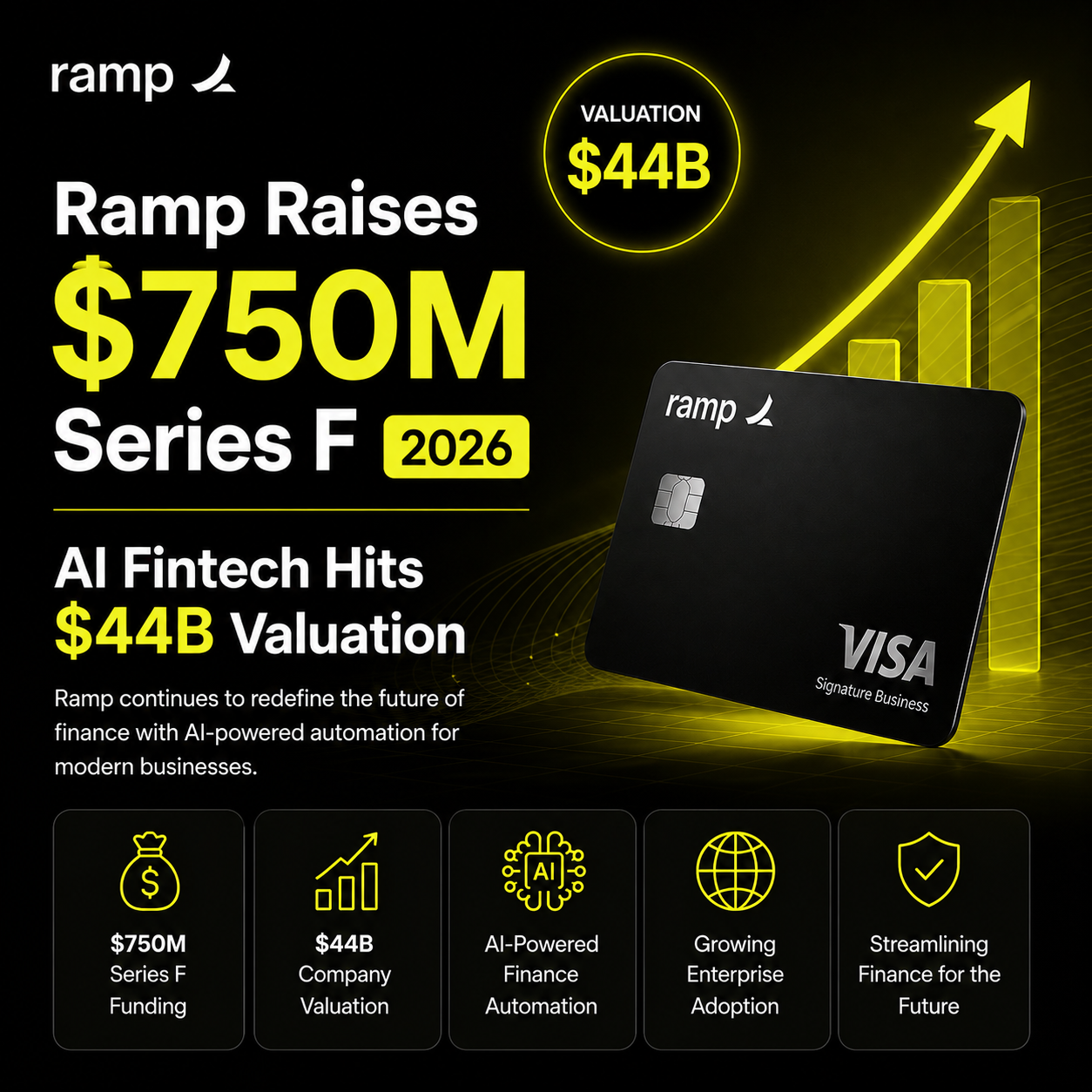
Ramp has raised $750 million in a Series F funding round at a $44 billion valuation, cementing its position as America’s most valuable private fintech company. The announcement on June 4, 2026 confirms what US enterprise CFOs already know: Ramp is no longer just a corporate card platform. It is building the AI operating system for corporate finance.

Table of Contents
What Is Ramp
Ramp is a New York-based financial operations platform founded in 2019 by Eric Glyman, Karim Atiyeh, and Gene Lee. The company unifies corporate cards, expense management, bill payments, procurement, and accounting into one AI-native system. Today Ramp serves more than 70,000 customers including Uber, Shopify, and Visa, and processes approximately $200 billion in annualized purchase volume across the US market.
Ramp Series F Funding Details 2026
The $750 million Series F round was led by ICONIQ Growth, GIC, and Ontario Teachers’ Pension Plan. Additional participants include Goldman Sachs Alternatives, D.E. Shaw, Morgan Stanley Investment Management, Generation Investment Management, Insight Partners, and BroadLight Capital. The round brings Ramp’s total equity raised to more than $3 billion since its 2019 founding.
The $44 billion valuation represents a near-tripling of Ramp’s previous valuation in under one year. That trajectory stands out even in the strongest venture markets and reflects institutional conviction in Ramp’s core business model and AI expansion roadmap. According to TechCrunch, investors are specifically drawn to Ramp’s AI narrative at a time when many fintechs are still struggling to articulate how artificial intelligence fits their product.
Why the $44 Billion Valuation Is Justified
Here is the thing. Valuations this high tend to raise skeptical eyebrows, but Ramp has built a genuinely defensible product that its customers depend on to manage billions in corporate spending. Its platform spans expense management, procurement, bill pay, and accounting in one integrated experience that finance teams at mid-market and enterprise companies consistently rank as a top operational priority.
Ramp also benefits from compounding network effects. Every new customer generates transaction data that improves Ramp’s AI models, which in turn creates better benchmarks and recommendations for the entire platform. The more businesses that use Ramp, the smarter and more valuable it becomes for everyone. This dynamic is what separates AI-native platforms from traditional software that simply adds AI features on top of legacy architecture.
The US startup ecosystem moves at a relentless pace. Stay ahead of every landmark funding round, founder story, and policy shift that matters to American builders.
👉 Track US Startup Funding at BestStartup.us
Ramp’s AI Operating System for Corporate Finance
Ramp has been assembling what it describes as an AI operating system for finance. This means embedding AI agents directly into procurement workflows, expense approvals, vendor negotiations, and now accounting. Alongside the Series F announcement, Ramp launched a new accounting product that gives finance teams real-time visibility into their books without manual reconciliation. This is a direct challenge to legacy platforms like NetSuite and QuickBooks at the enterprise tier.
Most boldly, Ramp launched a corporate credit card designed specifically for AI agents to use autonomously. As businesses deploy AI systems that purchase software, cloud compute, and API credits without human intervention, traditional corporate card controls break down completely. Ramp’s AI agent card gives finance teams granular visibility and real-time control over every autonomous transaction within their organization. This is genuinely new territory and puts Ramp well ahead of incumbents on the AI-native infrastructure layer.
The Investors Behind Ramp’s Series F
The caliber of investors in this round deserves attention. ICONIQ Growth has backed companies like Facebook, Twitter, and Airbnb at critical inflection points. GIC is Singapore’s sovereign wealth fund and rarely invests in fintech at this stage unless the risk-reward profile is highly compelling. Ontario Teachers’ Pension Plan manages one of Canada’s largest pension funds and is known for measured positions in category-defining companies. The presence of Goldman Sachs and Morgan Stanley alongside traditional VC names signals that smart institutional money and growth-stage specialists agree on Ramp’s trajectory.
What Ramp’s Rise Means for US Startups
For US startup founders and CFOs, the Ramp Series F signals that the era of bloated and disconnected finance stacks is ending. Companies still relying on separate tools for expense reporting, procurement, and accounting are leaving both efficiency and data on the table. Ramp has built a compelling case that consolidating financial operations into one AI-native platform produces measurable savings that justify a full migration from legacy systems.
This is also a signal for builders. Enterprise software built around AI workflows rather than AI features bolted onto legacy code commands premium valuations in 2026. For founders in the finance and operations space, Ramp sets the standard for what an AI-first operating system looks like at scale. Read our earlier coverage of the Google and SpaceX compute deal for further context on how AI infrastructure investment is reshaping the entire US tech stack from the ground up.
Key Takeaways
Ramp’s $750 million Series F at a $44 billion valuation is the largest US fintech funding round of 2026 so far. The round is led by ICONIQ Growth, GIC, and Ontario Teachers’ Pension Plan and brings total equity raised to more than $3 billion. Ramp serves 70,000 customers processing $200 billion annually and has launched AI-native products including a real-time accounting platform and an AI agent corporate card. The round confirms investor conviction that AI-first financial operating systems will displace legacy finance tools across the US enterprise market within the next five years.
America’s startup ecosystem never sleeps. Do not miss the next landmark deal, breakout founder, or policy shift shaping US innovation.
👉 Follow US Startup News at BestStartup.us
How much did Ramp raise in its Series F?
Ramp raised $750 million in its Series F round announced on June 4, 2026. The round pushed Ramp’s valuation to $44 billion and brought total equity raised to more than $3 billion.
What is Ramp’s valuation in 2026?
Ramp’s valuation reached $44 billion after its Series F in June 2026, nearly tripling its previous valuation in under one year and making it the most valuable private fintech company in the United States.
Who led Ramp’s $750M funding round?
The round was led by ICONIQ Growth, GIC, and Ontario Teachers’ Pension Plan. Additional investors include Goldman Sachs Alternatives, D.E. Shaw, Morgan Stanley, Insight Partners, and BroadLight Capital.
What AI products did Ramp launch alongside its Series F?
Ramp launched a real-time accounting product and a corporate credit card designed for AI agents to use autonomously. The AI agent card gives finance teams visibility and control over every autonomous AI transaction inside their organization.
How many customers does Ramp have?
Ramp serves more than 70,000 customers as of 2026, including Uber, Shopify, and Visa. The platform processes approximately $200 billion in annualized purchase volume across its US customer base.