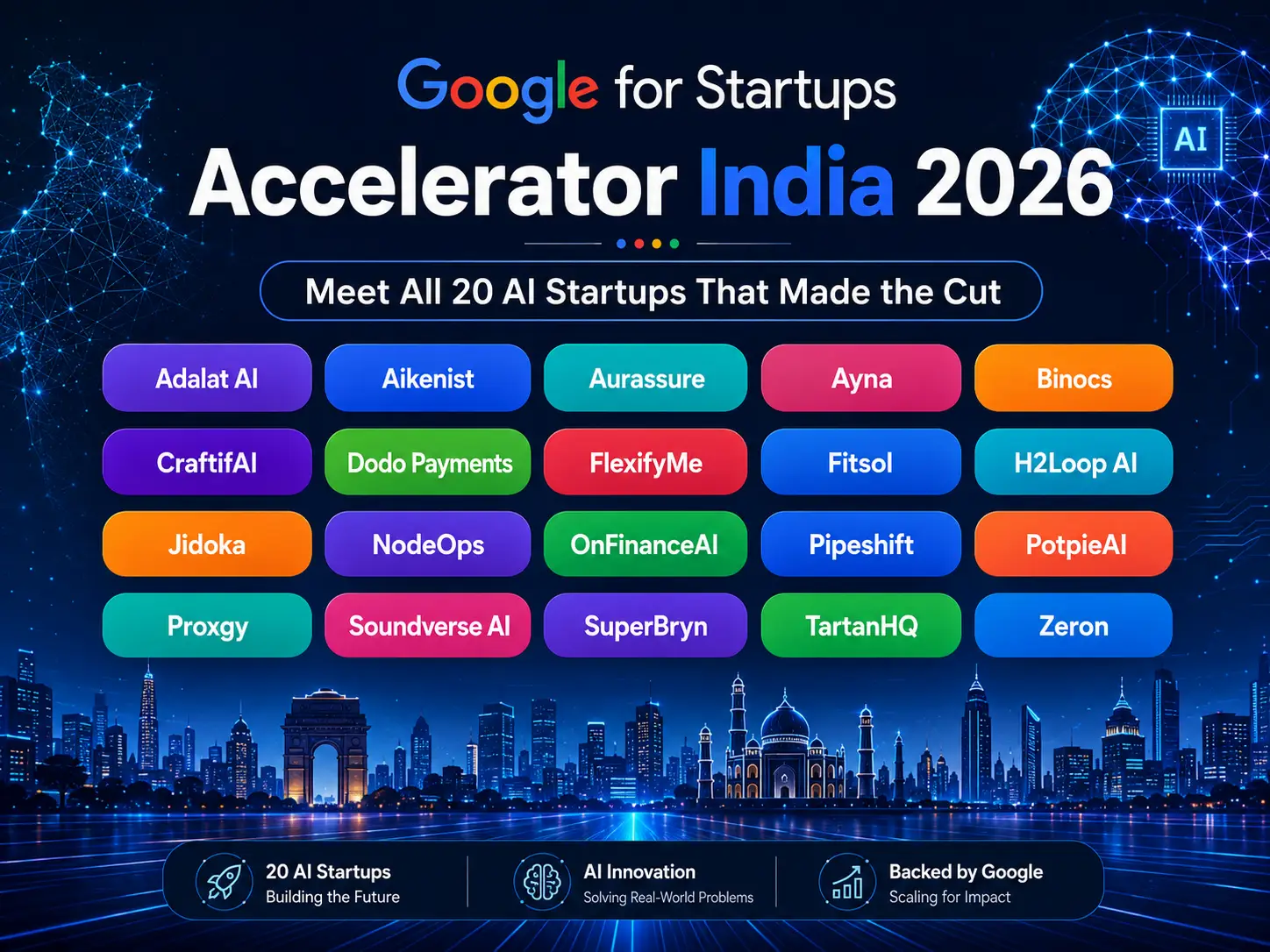
Out of 2,500 applications submitted from across India, only 20 startups earned a place in one of the most competitive accelerator programmes of 2026. The Google for Startups Accelerator: India 2026 cohort has been officially confirmed and the companies selected are a blueprint for where Indian AI innovation is headed next.
Each of the 20 selected startups completed a rigorous in-person bootcamp at Google’s Bengaluru campus before the cohort was publicly announced on July 9, 2026. Together they span legal AI, radiology automation, climate tech, fintech compliance, embedded systems, music generation, cybersecurity, and consumer commerce — a wide-angle snapshot of India’s AI economy in full flight.
What Is the Google for Startups Accelerator: India?
Google launched its India Startup Accelerator in April 2024 as part of its broader global accelerator network. The programme gives selected startups access to Google’s full AI stack — Gemini, Google Cloud, and Vertex AI alongside direct mentorship from senior Google engineers and product leads. It is not a direct funding programme. What startups receive instead is technical depth, architectural guidance, and the credibility of a Google-backed profile when pitching enterprise clients and institutional investors globally.
📌 Also read: Top 10 AI Business Communication Startups 2026 | Together AI Raises $800M Series C
Previous cohorts included Apptile, Knit, MyWonder, Phot.AI, and SparkyAI. The 2026 batch is notably broader in sector spread and global ambition. As Google India Vice President and Country Manager Preeti Lobana said at the announcement: “By equipping these pioneering founders with Google’s full AI stack and deep technical mentorship, we are not only accelerating their path to global enterprise scale but also cementing the sovereign capabilities required to advance the India AI Mission and build a resilient, inclusive digital economy.”
The Numbers Behind the 2026 Selection
A selection rate of just 0.8% — 20 chosen from 2,500 applicants — tells you everything about the bar Google set for this cohort. The selected startups are headquartered across eight cities: Bengaluru, Delhi NCR, Mumbai, Chennai, Pune, Bhubaneswar, San Francisco, and New York. India’s AI ecosystem, long considered a Bengaluru story, is clearly spreading its roots. The cohort collectively addresses markets from ₹19-crore enterprise data breaches to the global $1.6 trillion decarbonisation opportunity — the ambition matches the selection rigour.
Legal, Finance and Compliance AI
Four startups in this cohort are attacking the unglamorous but enormously valuable world of legal, financial, and risk compliance — each from a structurally different angle.
Adalat AI (Delhi NCR, est. 2023), incubated at MIT, is building AI tools for India’s chronically backlogged legal system. Its products include courtroom dictation, speech transcription, and case workflow automation — enabling lawyers and courts to process far more cases without hiring additional headcount. Co-founders Utkarsh Saxena and Arghya Bhattacharya are targeting a system where case backlogs run into tens of millions.
Binocs (Bengaluru, est. 2022) automates enterprise due diligence and financial intelligence. Backed by Accel, Blume Ventures, BEENEXT, Arkam Ventures, and Better Capital, it handles deal sourcing, portfolio monitoring, and investment research — work that consumes hundreds of analyst hours per quarter at investment banks and private equity firms.
OnFinanceAI (Bengaluru, est. 2023) has raised over $5 Mn from Peak XV Partners, Silverneedle Ventures, IAN Group, and Stargazer Fund. Its NeoGPT platform automates compliance, audit, and regulatory workflows for banks, insurers, and asset managers — sectors where the cost of an error is existential and demand for reliable AI automation is accelerating rapidly as Reserve Bank of India regulations tighten.
Zeron (Mumbai, est. 2020), backed by 100X.VC and Varanium Capital, unifies enterprise security tool data to deliver continuous cyber risk quantification, attack surface management, and AI-driven remediation from a single control plane. With the average cost of a data breach in India exceeding ₹19 crore, Zeron’s timing could not be sharper.
Health, Wellness and Life Sciences AI
Aikenist (Bengaluru, est. 2019) brings seven years of field experience to the cohort. Its AI-powered radiology products — QuickScan and QuickDiag — accelerate MRI processing and automate disease detection for hospitals grappling with radiologist shortages and rising imaging demand. Founders Amarapuram Chandramouly Ashwin and Venkatesh Kempapura Sharma are addressing a market where diagnostic delay directly costs lives.
FlexifyMe (Pune, est. 2021) offers a non-surgical answer to chronic musculoskeletal pain — one of India’s most underserved health challenges. Its AI prescribes personalised physiotherapy, yoga, and lifestyle programmes to patients, reducing the need for clinical interventions that India’s overstretched hospital system cannot provide at the scale required.
SuperBryn (Bengaluru, est. 2025) is the newest startup in the cohort and arguably its most forward-looking. Founded by Nikkitha Shanker and Neethu Mariam Joy, it builds reliability infrastructure for enterprise Voice AI agents — identifying accent recognition failures, noisy environment errors, and production edge cases before they reach customers. As enterprises race to deploy voice agents for customer service at scale, SuperBryn builds the quality control layer that makes those deployments trustworthy.
Deep Tech, Infrastructure and Developer Tools
Five cohort members operate at the infrastructure layer of the AI stack — the picks and shovels of the 2026 AI gold rush.
CraftifAI (Bengaluru, est. 2024) has raised $3 Mn from Ankur Capital and IvyCap Ventures to build an agentic platform that automates embedded software and firmware generation for IoT, robotics, automotive, and industrial edge devices — markets where AI deployment is currently throttled by a shortage of embedded engineers globally.
H2Loop AI (Bengaluru, est. 2024), backed by Speciale Invest and 3one4 Capital, develops domain-specific AI models for semiconductor, automotive, aerospace, telecom, and defence verticals. Founders Sairanjan Mishra and Pulkit Agrawal are automating embedded and system software development — a category almost untouched by AI disruption until now.
Pipeshift (San Francisco & Bengaluru, est. 2024) emerged from Y Combinator’s Summer 2024 batch. It builds an inference orchestration platform for open-source AI models with ultra-low latency across cloud and on-premise environments — directly challenging hyperscaler-lock-in on enterprise ML deployment costs.
PotpieAI (San Francisco, est. 2023) constructs a knowledge graph connecting source code, documentation, logs, APIs, and databases, enabling AI agents to autonomously navigate and complete tasks inside massive, complex enterprise codebases. For engineering organisations managing millions of lines of legacy code, this is transformative productivity infrastructure.
CreateOS by NodeOps (Bengaluru, est. 2023) has raised $5 Mn from L1D, Blockchain Founders Fund, and Finality Capital to bridge Web3 infrastructure and enterprise AI compute — its decentralised cloud platform allows one-click deployment of blockchain nodes, AI workloads, and decentralised apps.
Climate, Sustainability and Industrial AI
Aurassure (Bhubaneswar, est. 2022), backed by Rainmatter and Unicorn India Ventures, combines IoT sensors with AI analytics to deliver hyperlocal monitoring of air quality, water levels, and other environmental parameters. It represents India’s conviction that climate data infrastructure — not just clean energy — is itself a fundable, scalable business category.
Fitsol (Delhi NCR, est. 2022) is building Decarbonisation-as-a-Service (DaaS) for enterprise clients in automotive and industrial manufacturing, helping them measure and reduce Scope 1, 2, and 3 carbon emissions. As ESG reporting mandates tighten globally, Fitsol moves from a nice-to-have to a regulatory necessity for large supply chains.
Jidoka (Chennai, est. 2018) is the most experienced startup in the batch — eight years of deploying computer vision and industrial AI for automated visual quality inspection, defect detection, and process optimisation in manufacturing and logistics. Global clients in industries where a single defect triggers costly product recalls rely on Jidoka’s precision.
Commerce, Payments, Wearables and Creative AI
Ayna (Bengaluru, est. 2023) raised $1.5 Mn from Inflexor Ventures and Faad Network to eliminate physical photo studios for fashion and e-commerce brands. Its AI generates studio-quality product images, virtual models, and AI photoshoots — compressing days of traditional production into minutes.
Dodo Payments (Bengaluru, est. 2024), backed by Antler, 100Unicorns, and Venture Catalysts, is building a merchant-of-record platform handling global payments, billing, tax compliance, and fraud management across 150+ countries. It removes the compliance friction that prevents Indian SaaS and AI companies from successfully selling internationally.
TartanHQ (Delhi NCR, est. 2021) connects enterprise workflows through HyperSync, HyperVerify, and HyperApps — delivering real-time data synchronisation, identity and income verification, and AI-powered onboarding APIs that banks and fintechs need to operate at scale without building bespoke integrations.
Proxgy (Delhi NCR, est. 2020) has raised over $7.7 Mn — investors include Nikhil Kamath and Suneil Shetty — to build AI and IoT-powered smart wearables for frontline and industrial workers. Products like SmartHat, Sleefe, and AudioPod improve safety and connectivity in environments where smartphones are impractical.
Soundverse AI (New York, est. 2023) gained national visibility on Shark Tank India Season 5. Its GenAI music platform lets anyone create, edit, and master studio-quality tracks through natural language prompts — no music theory required. AI generation, lyric writing, stem separation, and intelligent editing tools are making professional music production genuinely democratic.
What Being Selected Really Means for These Startups
Admission to the Google for Startups Accelerator: India 2026 is more than a badge — it is a structural advantage at a decisive moment. Google works directly with each startup to refine their architecture on Google Cloud, optimise AI model performance, and sharpen enterprise sales narratives needed to close large contracts. The programme opens doors to Google’s global partner ecosystem, which can accelerate international expansion for startups like Dodo Payments, Pipeshift, Soundverse AI, and PotpieAI that already operate with global ambitions baked into their founding thesis.
For investors tracking India’s AI ecosystem, this cohort also functions as a curated due diligence signal. At a 0.8% selection rate, Google’s team has validated these 20 companies in a way that the broader market can now reference. Watch this cohort closely — several of these names will almost certainly be raising Series A and B rounds within the next 18 months.
🚀 Stay Ahead of India’s Startup Scene
BestStartup.us tracks funding rounds, accelerator picks, and breakthrough companies across the US and India every week. Bookmark us and never miss the next big move in the startup world.
👉 Latest US Startup Funding Rounds | Top AI Tools Reshaping Business in 2026
Frequently Asked Questions
What is Google for Startups Accelerator India 2026?
Google for Startups Accelerator India 2026 is a flagship programme giving 20 selected AI-first Indian startups access to Google’s full technology stack including Gemini, Google Cloud, and Vertex AI, plus direct mentorship from senior Google engineers. The 2026 cohort was chosen from 2,500 applications.
How many startups did Google select for its India accelerator in 2026?
Google selected 20 startups for its India accelerator 2026 cohort from over 2,500 applications, a selection rate of just 0.8%. Each startup completed an in-person bootcamp at Google’s Bengaluru campus before the cohort was officially announced.
Which startups were selected for Google for Startups Accelerator India 2026?
The 20 selected startups are: Adalat AI, Aikenist, Aurassure, Ayna, Binocs, CraftifAI, Dodo Payments, FlexifyMe, Fitsol, H2Loop AI, Jidoka, CreateOS by NodeOps, OnFinanceAI, Pipeshift, PotpieAI, Proxgy, Soundverse AI, SuperBryn, TartanHQ, and Zeron.
Does the Google Startup Accelerator India give funding?
No. Google for Startups Accelerator India does not provide direct equity funding. Startups receive access to Google’s AI technology stack, cloud credits, technical mentorship, and architectural support to help them scale products and win enterprise clients.
When was the Google India Startup Accelerator launched?
Google launched the Google for Startups Accelerator India in April 2024. The 2026 cohort, announced in July 2026, is the programme’s third batch. Previous cohorts included startups like Apptile, Knit, MyWonder, Phot.AI, and SparkyAI.
Related coverage: US Startup Funding Rounds June 2026 | Together AI $800M Series C | Top 10 AI Business Communication Startups 2026