In the broader consumer services sector, home improvement and residential landscaping have long been dominated by legacy business models: hyper-local independent contractors, regional mow-and-blow crews, or bloated national franchises. For decades, these operators relied on a predictable, cyclical revenue loop driven by routine maintenance, turf fertilizing, and manual seasonal lawn repairs.
However, a compounding intersection of macroeconomic pressures is rapidly rendering the traditional residential lawn obsolete. Aggressive municipal utility inflation, structural water shortages across high-growth secondary markets, and shifting consumer demands for turnkey, “lock-and-leave” properties have transformed the classic grass yard into a significant financial liability.
Nowhere is this shift more evident than in the Sunbelt. In fast-growing metropolitan hubs like Phoenix and Scottsdale, Arizona, keeping a natural lawn green through blistering 120°F summers has evolved from a routine chore into an unsustainable financial burden. Monthly residential water bills frequently exceed $300 just to keep patchy Kentucky Bluegrass alive in soil that was never designed to support it.
This extreme environmental and economic friction has created a “blue ocean” market opportunity. A new wave of agile, specialized landscaping startups is stepping in, utilizing advanced materials science and integrated hardscaping to completely disrupt the traditional outdoor living industry.
The Macro Economics of Asset Optimization Under Severe Weather Realities
For the modern real estate investor, property manager, and high-net-worth homeowner, the definition of residential luxury has fundamentally changed. Visual appeal is no longer enough; a property’s outdoor footprint must display structural resilience and operational efficiency.
When a traditional living lawn degrades under climatic stress, it triggers a cascade of compounding asset depreciation costs:
- Elevated Operational Expenses (OpEx): Continuous water consumption paired with tiered municipal scarcity pricing dramatically inflates fixed utility overhead.
- Soil Degradation and Structural Attrition: Extreme heat dries out topsoil, creating “dust bowls” that allow invasive weeds to compromise surrounding property grading.
- Interior Friction: Degraded yards turn into mud or dust pits that are continuously tracked inside, damaging premium interior flooring and accelerating property wear-and-tear.
To bypass this cycle of depreciation, innovative regional operators are approaching site development as a precise engineering problem rather than a basic gardening task.
The Financial Performance Matrix: Traditional vs. Engineered Landscapes
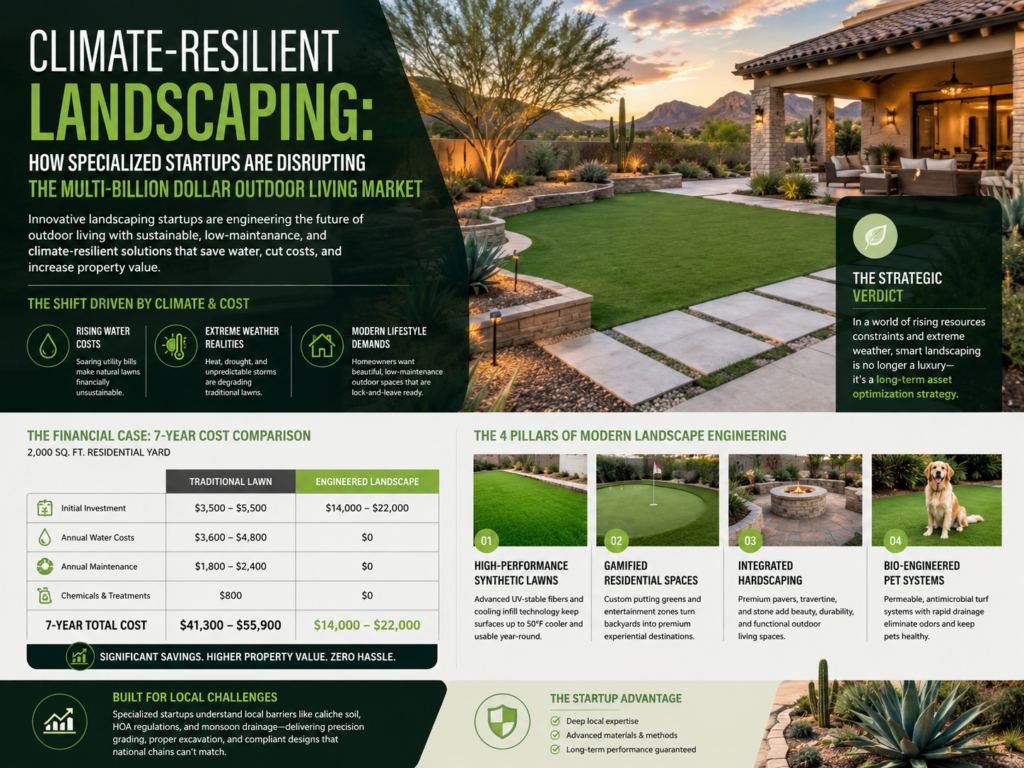
To evaluate the long-term asset value of this structural transition, consider the multi-year financial trajectory of a standard 2,000-square-foot residential suburban yard footprint over a standard seven-year real estate holding cycle:
| Operational Cost Center (2,000 Sq. Ft. Footprint) | Legacy Living Turf Infrastructure | Capitalized Synthetic & Stone Engineering | Portfolio Valuation Effect |
| Initial Capital Expenditure (CapEx) | Low ($3,500 – $5,500) | Moderate ($14,000 – $22,000) | Amortized instantly into core property equity and curb appeal appraisal. |
| Annual Water Utility Costs | $3,600 – $4,800 | $0 | Immediate insulation from municipal water utility price hikes. |
| Annual Labor, Equipment, & Mowing Contracts | $1,800 – $2,400 | $0 | Complete elimination of recurring vendor scheduling and fuel surcharges. |
| Seasonal Overseeding & Chemical Treatment | $800 | $0 | Eradicates chemical runoff liabilities and soil contamination risks. |
| 7-Year Cumulative Cost-of-Ownership | $41,300 – $55,900 | $14,000 – $22,000 | Net operational savings directly scale localized asset value. |
Disruption Through Specialization: The Four Core Pillars of Modern Landscape Engineering
The startups winning this space—exemplified by regional market leaders like Professional Artificial Turf Scottsdale—do not look like traditional lawn care operations. Their business models are anchored in advanced materials science, complex sub-surface grading, and the seamless integration of four core outdoor service sectors.
1. High-Performance Synthetic Lawns
Modern installations bypass the core flaws of early-generation artificial grass, which was prone to severe heat retention and fading. Current commercial-grade installations leverage advanced polymer science featuring built-in UV stabilizers and specialized cooling infill tech. This material innovation reduces surface temperatures by up to 50 degrees compared to standard synthetic materials, allowing the lawn to remain highly usable even during intense summer afternoons.
2. Gamified Residential Spaces
Homeowners are increasingly looking to bring luxury, commercial-grade experiences directly into their private properties. By designing and installing backyard putting greens tailored for true ball roll and professional-circuit performance, specialized startups are turning plain, unused grass zones into high-value experiential spaces. This targeted modification changes the entire layout of a yard, turning a high-maintenance area into a premium center for home entertainment.
3. Integrated Architectural Hardscaping
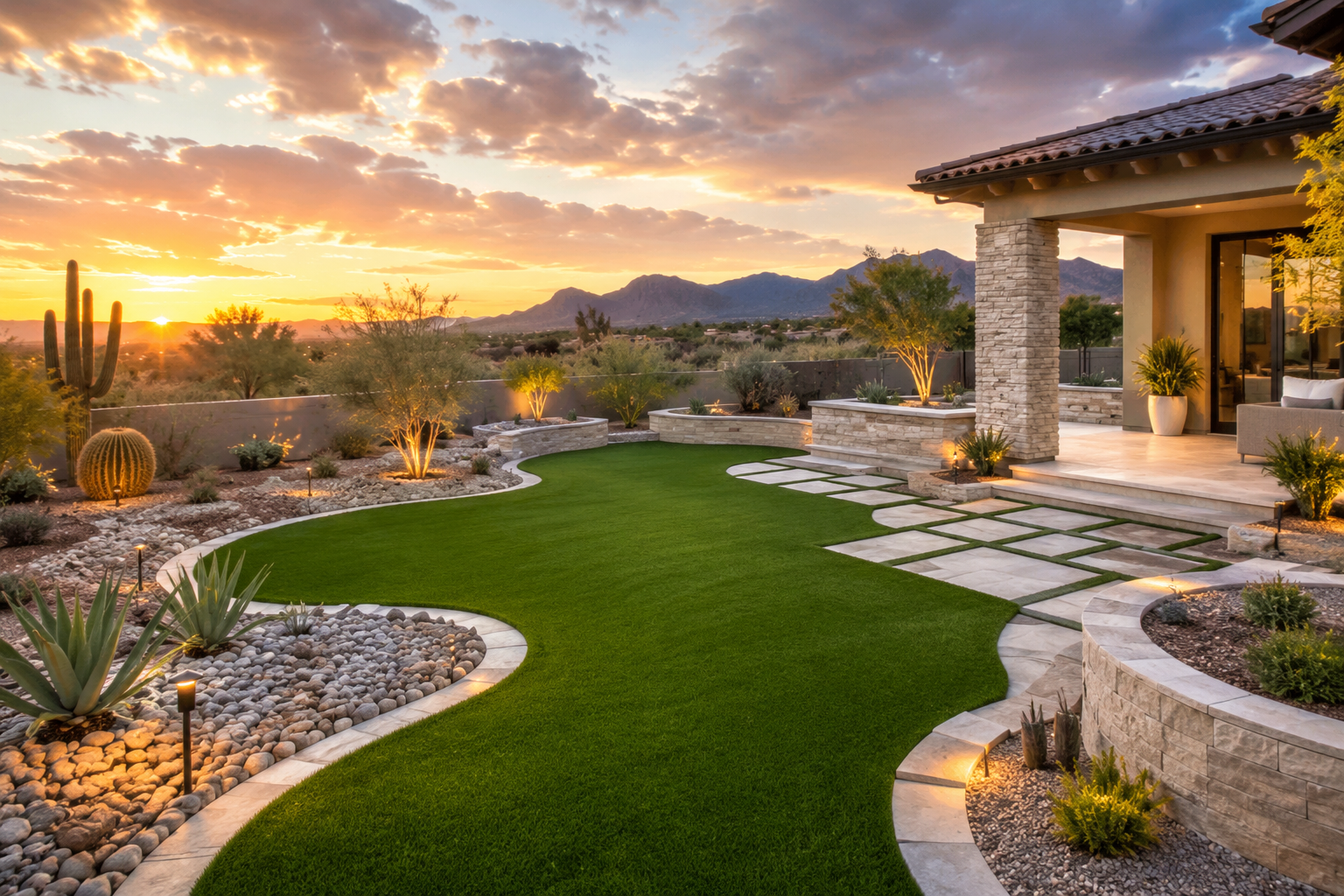
A resilient landscape design rarely relies on a single material. Achieving a true resort-style look requires a precise balance of soft synthetic turf textures and permanent, durable stone elements. Top-tier installation firms are blending synthetic lawns with premium travertine & paver installation to build custom patios, sleek walkways, and crisp geometric borders. This smart combination delivers lasting durability while building clean, permanent boundaries that require absolutely zero long-term maintenance.
4. Bio-Engineered Animal Infrastructure
As pet ownership hits historic highs among primary real estate purchasing demographics (Millennials and Gen Z), properties without dedicated animal amenities face faster wear and tear. Specialized teams solve this by installing heavy-duty pet-friendly artificial turf systems engineered with completely porous backing layouts. This architecture facilitates rapid water and waste drainage at a rate of over 30 inches per hour, working alongside specialized antimicrobial infills to eliminate odors and stop bacteria growth at the source.
+————————————————————-+
| ANATOMY OF A RESILIENT BIO-ENGINEERED TURF SYSTEM |
+————————————————————-+
| SURFACE: Anti-Microbial Synthetic Turf Fibers (UV Stable) |
+————————————————————-+
| INFILL: Ammonia-Neutralizing Acrylic / Zeolite Granules |
+————————————————————-+
| BACKING: Maximum Porosity Rapid-Drainage Matrix |
+————————————————————-+
| SUB-BASE: Multi-Tier Compacted Crushed Aggregate Layer |
+————————————————————-+
Overcoming Local Site Barriers: The Startup Defensive Moat
The reason generic national franchises struggle to compete with specialized regional startups down in the trenches comes down to local site realities. In Southwestern markets like Arizona, installers face two massive structural challenges: caliche and strict Homeowners Association (HOA) regulations.
Caliche—a rock-hard underground layer of calcium carbonate cemented together over thousands of years—behaves more like concrete than soil. Generic crews attempting quick surface fixes often ignore it, leading to uneven settling, poor sub-base drainage, and surface rippling over time.
Expert regional startups build their competitive moat by mastering the specialized tools, heavy excavation equipment, and grading techniques needed to break through caliche. They build flawless, highly functional drainage channels and perfectly level base matrices that can easily handle the severe, concentrated downpours of monsoon seasons.
Furthermore, navigating strict regional HOA guidelines requires deep local compliance experience. A specialized team ensures that the turf’s blade profile, color balance, and hardscape transitions perfectly match strict neighborhood aesthetic rules, eliminating the risk of costly post-installation fines or code violations.
The Strategic Verdict
The ongoing transformation of the residential outdoor living market highlights a broader economic reality: in a world facing rising resource constraints and unpredictable weather patterns, simplicity and efficiency win. Moving away from traditional, high-maintenance lawns in favor of integrated, high-performance synthetic turf and hardscape systems represents a lasting structural upgrade for any property.
For real estate innovators, property tech investors, and forward-thinking homeowners, optimizing a landscape from the sub-grade up is no longer just a cosmetic choice. It is a calculated asset management strategy that cuts operating costs, eliminates maintenance friction, and locks in property value for years to come.
Frequently Asked Questions
What is climate-resilient landscaping?
Climate-resilient landscaping uses drought-tolerant plants, permeable surfaces, rain gardens, and native species to create outdoor spaces that withstand extreme weather events like heat waves, heavy rain, and drought.
Which startups are leading climate-resilient landscaping?
Startups like Yardzen, Grounded, TerraTrue, and SavATree are combining AI design tools, native plant databases, and sustainable installation networks to scale climate-resilient outdoor spaces for residential and commercial clients.
How does climate-resilient landscaping reduce water usage?
By replacing traditional lawns with drought-tolerant plants, drip irrigation systems, and permeable hardscaping, climate-resilient landscapes can reduce outdoor water usage by 50 to 75% compared to conventional lawns.
Is climate-resilient landscaping more expensive?
Initial installation costs can be 10 to 30% higher than traditional landscaping. However, climate-resilient designs typically reduce long-term maintenance costs by 40 to 60% through lower water bills and reduced upkeep requirements.
What are native plants and why do they matter for climate resilience?
Native plants are species that evolved naturally in a specific region. They require less water, support local pollinators, and are more resilient to local climate extremes than exotic ornamental plants imported from different climates.
Can AI help design climate-resilient landscapes?
Yes. AI platforms like Yardzen use property data, climate zone information, and plant databases to generate customised landscape designs optimised for local conditions, water availability, and maintenance preferences.
Related coverage: Together AI $800M Series C | Flourish $500M Brain-Inspired AI | US Startup Funding Rounds June 2026