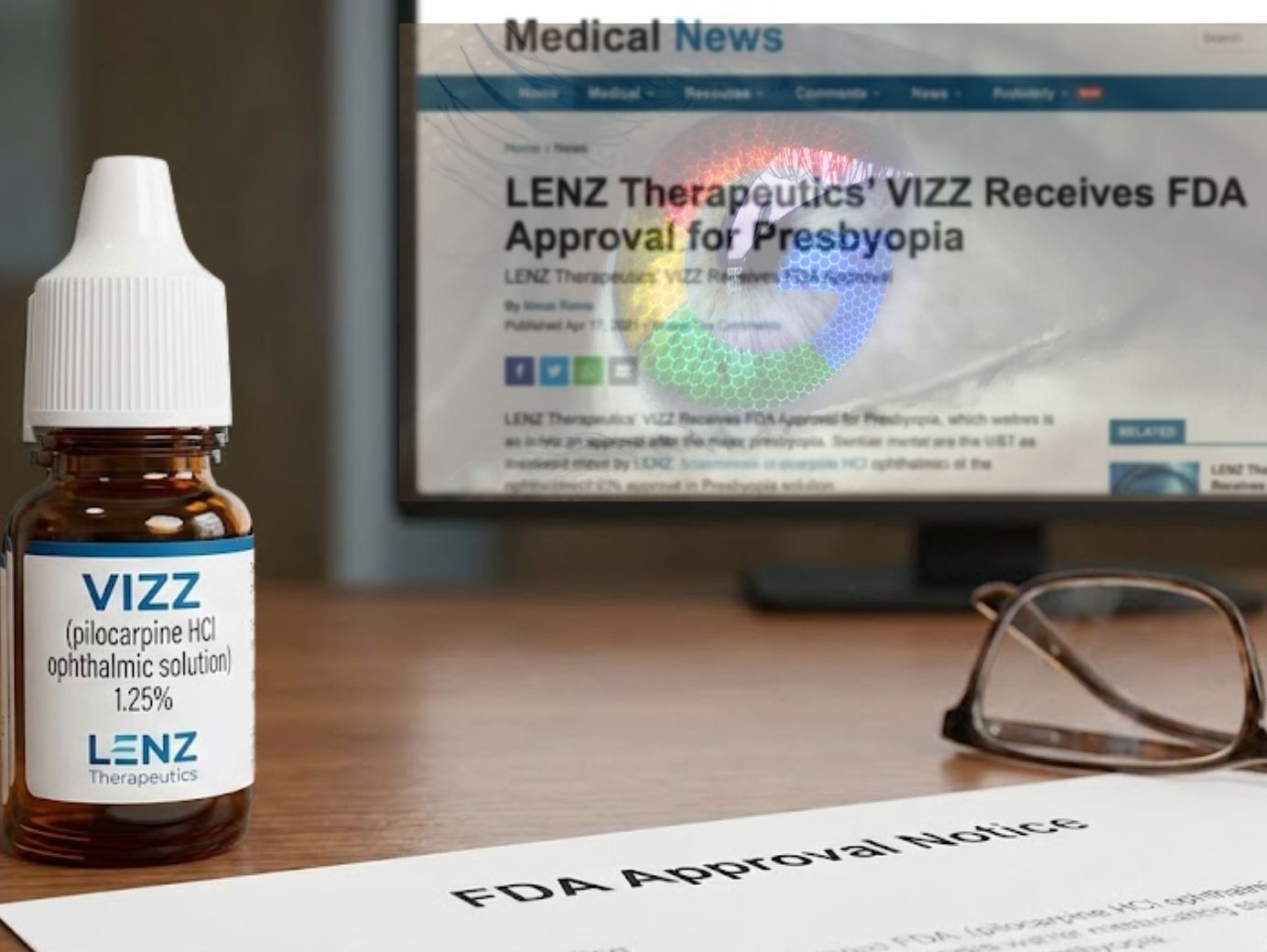
VIZZ Eye Drops by LENZ Therapeutics: Transforming Near Vision Care for Adults
Introduction
Presbyopia affects over 128 million adults in the United States alone, making up-close tasks like reading and using smartphones a daily challenge. Traditional treatments—from reading glasses to multifocal contact lenses—bring inconvenience, constant switching, or discomfort. VIZZ eye drops are changing the landscape, offering a medical and lifestyle advancement for millions.
Read More…How VIZZ Works: Scientific Perspective
The science of VIZZ hinges on its active ingredient, aceclidine. When applied, aceclidine selectively stimulates the iris sphincter muscle, producing a controlled “pinhole effect.” This effect increases depth of focus without causing blurry distance vision—a frequent drawback in older miotics.
VIZZ’s design focuses on pupil selection: the drop minimizes stimulation of the ciliary muscle, which is responsible for changing lens shape and can induce unwanted myopia in non-selective treatments. Instead, VIZZ maintains natural distance sight while allowing users to quickly regain near vision.
Read More…Who Should Use VIZZ?
– Individuals seeking a non-surgical, non-glasses solution
– Users with active lifestyles needing on-demand near vision clarity
– Those who have had LASIK or cataract surgery and desire further clarity
– Professionals, caregivers, and anyone frustrated by frequent reliance on reading glasses
VIZZ eye drops were tested in clinical trials on diverse U.S. adult populations, including patients with previous eye procedures. By prioritizing comfort and effectiveness, VIZZ addresses a wide demographic in the American market.
FDA Approval & Clinical Trials
| Trial Name | Participants | Duration | Efficacy | Safety |
|---|---|---|---|---|
| CLARITY 1 | 300+ | 42 days | Statistically significant improvement in near vision | Mild, transient adverse effects; no serious events |
| CLARITY 2 | 166 | 42 days | Rapid onset, sustained effect | Dim vision, site irritation ~20% |
| CLARITY 3 | 217 | 6 months | Long-term safety proven | No treatment-related serious events |
Usage Instructions
- Apply one drop in each eye daily, followed by a second drop after 2 minutes (same vial).
- Remove contact lenses prior to application and reinsert after 10 minutes.
- Separate multiple ophthalmic products by at least 5 minutes.
- Store unopened vials in the refrigerator; use within 30 days if kept at room temperature.
Safety Information
- Do not allow vial tip to touch eye or other surfaces.
- Retinal exams are advised before starting therapy.
- If experiencing flashing lights or floaters, discontinue and consult your physician.
Access & Pricing
| Option | Doses | Price |
|---|---|---|
| Monthly Subscription | 25 | $79/month |
| 3-Month Supply | 75 | $198 ($66/month) |
Check real-time access and pricing details. You can order with a doctor’s prescription, via local pharmacies, or directly to your door. Download the VIZZ Savings Card for extra benefits.
US Eye Care Innovation & VIZZ’s Impact
VIZZ’s approval marks a major advance in American eye care. It reflects growing adoption of non-invasive interventions that empower patients rather than restrict them. Medical innovators are focusing on technologies—like VIZZ and other nanobot-powered therapies—that offer genuine independence and comfort for U.S. adults.
The market for flexible, on-demand vision solutions is expanding, making the U.S. a leading hub for such disruptive healthcare products. That’s why VIZZ finds broad support among ophthalmologists, optometrists, and medical professionals prioritizing patient experience.
Related Innovations & Medical News
VIZZ is part of a wave of breakthrough technology in U.S. eye care and wider biotech. For deeper context, see:
Frequently Asked Questions
What is VIZZ?
VIZZ is an FDA-approved prescription eye drop for blurry near vision (presbyopia). Its active ingredient is Aceclidine.
How quickly does VIZZ work?
Most users experience improvement in near vision within 30 minutes of application.
Can I use VIZZ if I’ve had LASIK or cataract surgery?
Yes, VIZZ was studied in people who have had these surgeries, and is suitable for many adults. Consult your physician to confirm.
Are there side effects to VIZZ?
Common side effects include mild eye irritation, dim or dark vision, headache, and redness. Serious adverse events are rare.
Where can I learn more?
Review important medical information at the official VIZZ prescribing guide and the official VIZZ homepage.
References & Important Outbound Links
Follow BestStartup.US for the latest news, trends, and medical startup breakthroughs.
Frequently Asked Questions
What is LENZ Therapeutics’ VIZZ eye drop and what does it treat?
VIZZ (atropine ophthalmic solution 0.1%) is an FDA-approved prescription eye drop developed by LENZ Therapeutics to treat presbyopia — the age-related loss of near vision that affects nearly all people over 40. VIZZ works by temporarily constricting the pupil, which increases the depth of focus and allows patients to see up-and-close without reading glasses, with effects lasting approximately 6-10 hours per dose.
How is VIZZ different from other presbyopia eye drops like Vuity?
VIZZ (atropine 0.1%) differs from Allergan’s Vuity (pilocarpine 1.25%) in its active ingredient and mechanism. Atropine targets muscarinic receptors differently from pilocarpine, and LENZ’s formulation is designed to minimise side effects including night vision changes. Clinical trials showed VIZZ provided meaningful near vision improvement in a significant percentage of patients. The two drugs target the same condition via different pharmacological pathways, giving patients and physicians treatment choices.
Who is a candidate for VIZZ presbyopia treatment?
VIZZ is indicated for adults with presbyopia — typically people aged 40 and over who have lost the ability to focus on near objects. It is suitable for patients seeking an alternative to reading glasses or contact lenses for distance-corrected near vision. Patients with narrow-angle glaucoma, hypersensitivity to atropine, or certain other eye conditions may not be candidates. An eye care professional evaluation is required before starting treatment.
What are the side effects of VIZZ eye drops?
The most commonly reported side effects of VIZZ in clinical trials include temporary blurred vision immediately after instillation, headache, eye redness, and photosensitivity. Atropine-class drugs can also cause pupil dilation effects in some patients. Most side effects were mild to moderate and transient. The specific side effect profile distinguishes VIZZ from pilocarpine-based drops, which more commonly cause brow ache and can worsen night vision.
What is presbyopia and how common is it?
Presbyopia is the gradual loss of the eye’s ability to focus on nearby objects, caused by age-related stiffening of the lens. It affects virtually everyone to some degree after age 40, making it one of the most prevalent vision conditions worldwide — an estimated 128 million Americans and 1.8 billion people globally have presbyopia. Until recently the only options were reading glasses, bifocal or progressive lenses, multifocal contact lenses, or surgical procedures.
Where can patients get VIZZ and what will it cost?
VIZZ is available by prescription through eye care providers including ophthalmologists and optometrists. Pricing for branded prescription eye drops in the US often runs $50–$100 per month depending on insurance coverage. LENZ Therapeutics has indicated it will work with payers to ensure access, though specific pricing and formulary placement will vary by insurance plan. Patients should check with their eye care provider and insurance plan for current cost and coverage information.
Related coverage: FDA Approves LENZ Therapeutics VIZZ Eye Drop | US Startup Funding Rounds June 2026 | Meet NEO — The Humanoid Robot by 1X Technologies