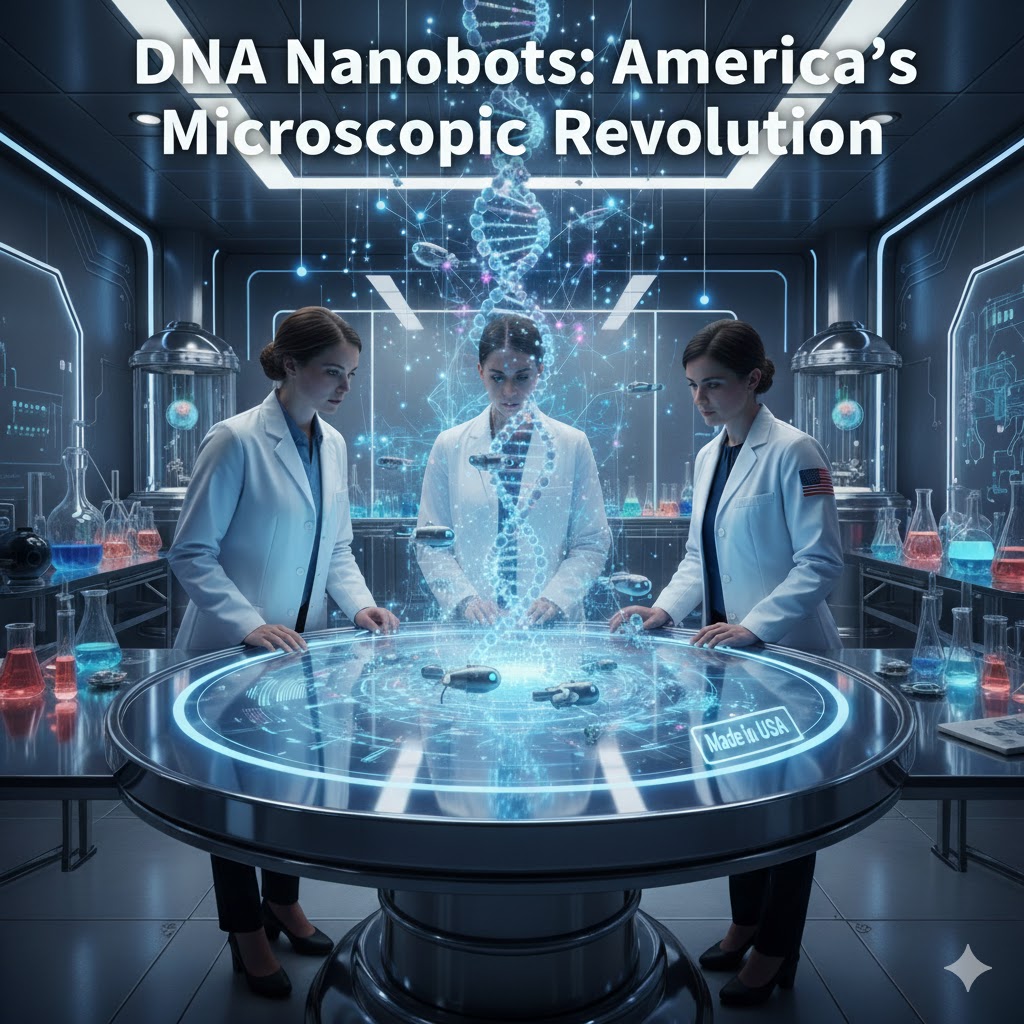
In the race to redefine modern medicine, DNA nanobots startups in the US are quietly building a microscopic army of molecular machines. These programmable bots, assembled from strands of DNA, can detect diseased cells, deliver targeted drugs, and even repair damaged tissue. Unlike traditional nanoparticles, DNA nanobots are biocompatible, self-assembling, and entirely programmable—qualities that make them the perfect tool for precision medicine.
The United States leads this emerging field with its unparalleled biotech infrastructure, academic depth, and bold investment networks. Institutions such as MIT, Caltech, and Harvard are not only pioneering nanobot design but also creating startup ecosystems that link research directly with commercialization. Backed by government initiatives like the National Nanotechnology Initiative (NNI), American biotech is already laying the groundwork for the next generation of therapeutic breakthroughs.
Top 10 DNA Nanobots Startups in the US
NuCure Therapeutics
Headquarters: Boston, MA
Innovation: DNA nanobots for targeted cancer drug delivery
Founded: 2018
Highlight: $65M Series B funding (2025)
Nanobotix Labs
Headquarters: San Diego, CA
Innovation: Self-assembling nanobots for tumor mapping
Founded: 2019
Highlight: UCSD partnership for clinical R&D
BioLogic NanoSystems
Headquarters: Austin, TX
Innovation: Programmable nanobots using DNA origami
Founded: 2020
Highlight: NIH Innovation Award (2024)
NanoGenesis Health
Headquarters: San Francisco, CA
Innovation: Smart nanobots for cell-level repair & diagnostics
Founded: 2017
Highlight: $48M raised; expanding into gene therapy
Genomic Botworks
Headquarters: New York, NY
Innovation: AI-guided nanobots for personalized medicine
Founded: 2019
Highlight: Collaboration with Mount Sinai Hospital
TheraNano Technologies
Headquarters: Seattle, WA
Innovation: DNA nanobots for immune system modulation
Founded: 2016
Highlight: NSF grant for immune therapy research
HelixNautics
Headquarters: Cambridge, MA
Innovation: DNA nanobots mimicking natural antibodies
Founded: 2021
Highlight: Pre-clinical trials with Harvard Medical School
OncoNano Research
Headquarters: Dallas, TX
Innovation: Nanobot-based early tumor detection systems
Founded: 2018
Highlight: $50M Series C; leading oncology nano-AI
NanoPath Diagnostics
Headquarters: Philadelphia, PA
Innovation: Diagnostic nanobots for rapid infection detection
Founded: 2020
Highlight: FDA fast-track status (2025)
CelluBot Therapeutics
Headquarters: Palo Alto, CA
Innovation: DNA-based bots for intracellular drug targeting
Founded: 2021
Highlight: $30M seed funding from BioFuture Ventures
Meet the Startups Defining the Future
Across the country, startups are building real-world applications for DNA nanobots—from targeted cancer therapies to tissue regeneration and autonomous diagnostic systems.
In Boston, Nanobots Therapeutics is developing programmable nanobots that identify and destroy tumor cells while leaving healthy tissue untouched. Down in San Diego, Molecular Machines Inc. focuses on molecular navigation systems that deliver genetic payloads to damaged cells.
Texas has joined the race through BioOrigami Labs, which engineers nanostructures that improve vaccine delivery, while NanoPulse Systems in New York works on imaging nanobots that track drug movement in real time. The innovation curve continues in Seattle, where PrecisionNano Health combines nanorobotics and gene editing to target antibiotic-resistant bacteria.
From San Francisco to Chicago and Austin to Miami, companies such as Nanovate BioDevices, DNAx Medical Robotics, QuantumNano Labs, MicroMed Nanotech, and NextGen DNA Robotics are transforming nanobot science into commercial biotech. These startups represent the cutting edge of American ingenuity—where biology, robotics, and computation converge to heal from within.
The Science and Policy Backbone
Behind these startups lies a strong scientific foundation and government backing that sets the US apart. DARPA’s Biodesign Program and the FDA’s Nanotechnology Task Force have accelerated research and established early safety frameworks for nanodevices.
Meanwhile, academic institutions such as Stanford Bio-X and Harvard’s Wyss Institute are advancing DNA nanobot design that responds to biochemical triggers—an essential step toward fully personalized medicine.
This synergy between public funding and private innovation allows US startups to commercialize faster while maintaining compliance and global credibility.
Challenges of Manufacturing and Regulation
Despite its potential, manufacturing DNA nanobots at scale remains a challenge. Each nanobot must be built with atomic precision, a process still limited by production speed and cost. However, breakthroughs in microfluidic assembly and automated DNA synthesis are promising to reduce costs by up to 70% over the next decade.
Regulation remains another hurdle, but the US continues to lead with the FDA’s evolving framework for nanoscale therapeutics, creating the blueprint for global nanobot regulation.
Investor Confidence and Market Momentum
Investor sentiment around DNA nanobots startups US is bullish. Funding in nanorobotics has surged more than 220% since 2023, signaling a new biotech frontier. Venture giants such as Lux Capital and ARCH Venture Partners are now directing capital toward nanomedicine, recognizing its potential to transform healthcare delivery.
Market forecasts suggest that the nanorobotics sector could exceed $12 billion by 2032, with nearly half of that value coming from US-based companies. This is not merely a scientific race—it’s an economic transformation built on the convergence of biology and automation.
The Promise of Molecular Medicine
The vision is bold yet tangible: a world where diseases are cured molecule by molecule. American DNA nanobots startups are at the epicenter of this transformation, building a new kind of healthcare system that’s proactive, adaptive, and precise.
If digital technology once redefined communication, nanorobotics will redefine healing. From cancer treatment to regenerative medicine, these startups are building the microscopic infrastructure of future healthcare.
Conclusion
The story of DNA nanobots startups in the US is not just one of innovation—it’s the story of how a nation’s scientific spirit can turn the invisible into the most powerful tool for survival. As research accelerates and regulation matures, America stands ready to unlock the potential of nanomedicine, setting the global benchmark for biotechnology in 2030 and beyond.
Explore more biotech innovators, funding data, and transformative startup stories shaping the future of healthcare at BestStartup.us where tomorrow’s industry leaders are featured today.
Frequently Asked Questions
What are DNA nanobots and how do they work?
DNA nanobots are nanoscale devices made from folded DNA strands that can be programmed to perform specific tasks inside biological systems. Using a technique called DNA origami, scientists fold synthetic DNA into precise 3D shapes that can carry drug payloads, detect molecular signals, or interact with cells at the nanoscale. They can be designed to open in response to specific molecular triggers — for example, releasing a cancer drug only when the nanobot detects markers on a tumour cell.
What are the leading US startups working on DNA nanobots?
The US leads global DNA nanobot research with a cluster of startups emerging from university labs at MIT, Harvard, Caltech, and Stanford. Companies including Arpeggio Biosciences, Selecta Biosciences, and a growing cohort of stealth-mode spinouts are translating academic DNA nanotechnology into therapeutic and diagnostic platforms. The field is also supported by DARPA contracts and NIH grants targeting targeted drug delivery and biosensing applications.
What medical applications are DNA nanobots being developed for?
Primary medical applications include targeted cancer drug delivery (releasing chemotherapy only at tumour sites), diagnostic biosensing (detecting specific biomarkers in blood or tissue at very low concentrations), gene therapy delivery vehicles, and programmable vaccines. The ability to programme nanobots to respond to specific molecular environments makes them particularly promising for diseases where systemic drug delivery causes intolerable side effects.
What is DNA origami and why is it important for nanobot development?
DNA origami is the technique of folding long single-stranded DNA into specific 2D and 3D shapes using short ‘staple’ strands that bind to specific locations along the scaffold. Developed by Paul Rothemund at Caltech in 2006 and significantly advanced since, DNA origami enables precise nanoscale engineering without the clean-room equipment required for silicon-based nanotechnology, making it scalable and cost-effective for biomedical manufacturing.
How close are DNA nanobots to clinical use?
DNA nanobot therapeutic applications are primarily at preclinical (animal model) and early Phase I human trial stages as of 2025. Several platforms using DNA-based nanocarriers for drug delivery have entered human trials, though fully programmable nanobots with autonomous decision-making remain further from clinical deployment. Regulatory pathways through the FDA are still being defined for this novel category of therapeutic.
What is the funding landscape for DNA nanobot startups in the US?
US DNA nanobot companies have attracted significant investment from both government sources (NIH, DARPA, NSF) and venture capital, with the broader nanomedicine sector receiving over $3 billion in venture investment in 2024. The intersection of DNA nanotechnology with AI-driven drug design is creating a new wave of investor interest as large language models accelerate the design of novel DNA sequences and nanostructures.
Related coverage: Meet NEO — The Humanoid Robot by 1X Technologies | Heat Pump Economics Are Finally Competitive | Future of Green Hydrogen in the U.S.