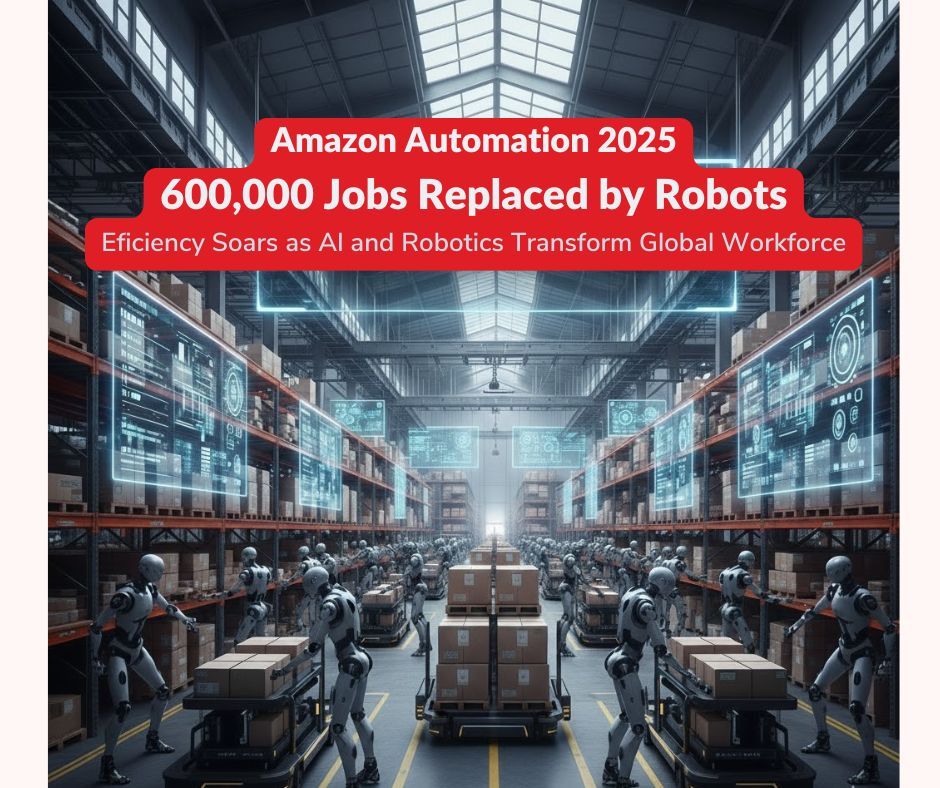
Amazon is accelerating its automation efforts, aiming to replace over 600,000 U.S. jobs with robots by 2027. This ambitious plan is part of a broader strategy to automate 75% of its operations by 2033, potentially saving the company $12.6 billion in labor costs between 2025 and 2027 The Verge+1.
Amazon’s Automation Strategy Explained
Internal documents suggest that Amazon’s robotics team plans to automate 75% of its operations, including warehouses and delivery systems, by 2033. This move is expected to reduce the need for approximately 160,000 new hires by 2027 The Verge. The company has already implemented advanced automation at its Shreveport, Louisiana facility, which now operates with 25-50% fewer workers due to the use of robots New York Post.
Financial Implications of Automation
The automation strategy is projected to save Amazon approximately $12.6 billion between 2025 and 2027. By reducing the need for human labor, the company aims to lower operational costs by about 30 cents per item shipped The Verge. Despite these savings, Amazon maintains that the move is not about mass layoffs but about improving efficiency and meeting growing demand.
Community Impact and Public Perception
Amazon is aware of the potential backlash from communities affected by job losses. Internal documents suggest that the company is considering strategies to mitigate negative public perception, such as avoiding terms like “automation” and “AI,” and instead using phrases like “advanced technology” and “cobots.” Additionally, Amazon is exploring increased participation in community initiatives to build goodwill The Verge.
Employee Transition and Retraining
To address the displacement of workers, Amazon is offering retraining programs aimed at transitioning employees into roles that support and manage the new technologies. These initiatives include apprenticeship programs for robot management and opportunities in AI and robotics maintenance. However, the success of these programs in fully replacing the displaced roles remains uncertain The Verge.
Recent Developments in October 2025
In October 2025, Amazon experienced significant leadership changes, with the departure of two vice presidents from its devices division. These exits coincide with the company’s efforts to restructure and focus on profitability, which includes reducing its product lineup and integrating generative AI into existing devices. Despite these internal changes, Amazon recently unveiled new devices and saw a share price increase of 1.1% to $220.36 Reuters.
Amazon’s Top Innovations of 2025
Amazon has been at the forefront of technological advancements in 2025, introducing a series of innovations aimed at enhancing operational efficiency, improving delivery services, and redefining the future of work. Below are the top five updates that have marked Amazon’s journey this year:
1. AI-Powered Smart Glasses for Delivery Drivers
In October 2025, Amazon unveiled AI-powered smart glasses designed specifically for its delivery drivers. These glasses, equipped with computer vision and AI capabilities, provide real-time navigation, package scanning, and hazard detection, allowing drivers to operate hands-free and reduce reliance on smartphones during deliveries Reuters.
2. Blue Jay and Project Eluna: Advanced Robotics and AI Integration
Amazon introduced two groundbreaking systems—Blue Jay and Project Eluna—to enhance warehouse operations. Blue Jay is a robotic system that coordinates multiple robotic arms to perform various tasks simultaneously, while Project Eluna is an agentic AI model that assists operators in making informed decisions. Together, these technologies aim to reduce repetitive tasks, improve safety, and boost productivity in Amazon’s fulfillment centers Reuters.
3. Expansion of Same-Day Delivery Capabilities
Leveraging AI and robotics, Amazon has significantly expanded its same-day delivery services. The integration of advanced technologies has enabled the company to process and deliver orders more efficiently, meeting the growing demand for rapid delivery times. This expansion underscores Amazon’s commitment to enhancing customer satisfaction through timely deliveries Reuters.
4. Skild Brain: A General-Purpose AI Model for Multi-Purpose Robots
Amazon-backed Skild AI introduced Skild Brain, a general-purpose AI model designed to operate across a wide range of robots. Unlike traditional single-function robots, those powered by Skild Brain can perform complex tasks such as climbing stairs, adapting to being pushed, and interacting with cluttered environments. This advancement represents a significant leap in robotics, enabling more versatile and adaptive robotic systems Reuters.
5. Amazon’s Robotics Workforce Surpasses Human Employees
In a significant milestone, Amazon’s robotic workforce has surpassed the number of human employees in its warehouses. With over 1 million robots deployed, these machines handle tasks such as lifting heavy items, sorting, and packaging goods, contributing to increased efficiency. Despite the rise in automation, Amazon has retrained over 700,000 employees for higher-paying, tech-enhanced roles, such as robot oversight and system maintenance About Amazon.
FAQs
1. How many jobs is Amazon planning to replace with robots?
Amazon plans to replace up to 600,000 U.S. jobs with robots by 2027 as part of its automation strategy The Verge.
2. What technologies is Amazon using for automation?
Amazon is employing advanced robotics like Proteus and Sequoia, as well as AI tools such as the Eluna agent, to automate tasks in its warehouses and delivery operations Reuters.
3. Will Amazon lay off employees due to automation?
Amazon asserts that the automation strategy is not about mass layoffs but about improving efficiency. However, the reduction in human labor through automation may lead to job displacement The Verge.
4. What is Amazon doing to support displaced workers?
Amazon is offering retraining programs and apprenticeship opportunities to help displaced workers transition into roles that support the new technologies The Verge.
5. How is Amazon addressing public concerns about automation?
Amazon is considering strategies to mitigate negative public perception, such as rebranding automation efforts and increasing participation in community initiatives The Verge.
Stay Ahead with Best Startup US
For the latest insights on Amazon automation, tech industry shifts, and game-changing startup trends, make sure to follow Best Startup US.
Get timely updates, exclusive interviews, and expert analysis on the future of innovation, automation, and employment.
Frequently Asked Questions
How many jobs has Amazon replaced with automation by 2025?
Amazon has deployed robots across its warehouse and logistics network at a scale that has displaced an estimated 600,000 positions from what its manual workforce would otherwise be. The company uses autonomous mobile robots for picking and sorting, AI-driven conveyor systems for package routing, and increasingly capable robotic arms for tasks that previously required human dexterity.
What types of jobs is Amazon automation replacing?
Amazon automation is replacing warehouse pickers, sorters, packers, inventory counters, and some delivery functions. The roles most affected are repetitive, physically demanding tasks performed in distribution centres. Human workers are being redeployed to roles involving exception handling, system oversight, robotics maintenance, and customer-facing activities that automation cannot replicate.
How is Amazon’s robotic workforce changing its competitive position?
Automation allows Amazon to process orders faster, operate facilities with lower labour costs, maintain 24/7 throughput without fatigue or human resource constraints, and scale capacity during peak periods without proportional headcount growth. This compounds its delivery speed and cost advantages over traditional retailers and smaller e-commerce competitors.
What does Amazon’s automation mean for the broader job market?
Amazon’s scale means its automation decisions have significant labour market effects. While the company argues it creates new roles in robotics and technology, independent economists note that the jobs created require different skills and are often fewer in number than those displaced. The transition is creating structural demand for retraining programmes in logistics and warehouse skills.
How are Amazon workers and unions responding to increased automation?
Worker advocacy groups and unions including the Amazon Labor Union have raised concerns about automation-driven pace increases, job insecurity, and inadequate retraining support. Some warehouse locations have negotiated technology introduction agreements requiring advance notice and transition assistance. The political pressure around automation and its labour impacts is intensifying at both state and federal levels.
What robotics companies is Amazon working with for its automation push?
Amazon develops much of its robotics technology in-house through its Amazon Robotics division (formerly Kiva Systems). It also partners with and acquires companies specialising in robotic arms, autonomous mobile robots, computer vision systems, and warehouse management software. The company’s scale makes it one of the largest funders of applied robotics R&D globally.
Related coverage: Meet NEO — The Humanoid Robot by 1X Technologies | Amazon’s Zoox Launches Robotaxi Service in Las Vegas | US Startup Funding Rounds June 2026