


Top 10 US Startup Funding Rounds January 2026-US startup funding in January 2026 has already crossed an estimated $1.5–1.8 billion in disclosed rounds, signaling a sharp rebound in venture confidence. Mega-deals across AI, healthcare SaaS, fintech, defense technology, biotech, and AI infrastructure are setting the tone for the year, with New York City and the San Francisco Bay Area emerging as the dominant capital magnets.



Early-2026 momentum reflects three powerful forces converging at once: a16z’s record $15B fundraise, renewed optimism around a biotech IPO comeback after a soft 2025, and sustained enterprise demand for AI-driven, compliance-ready, mission-critical software. The result is a decisive reset in US venture activity.
Market Context: Why January 2026 Matters for US Startups
Several macro signals frame these funding rounds. The US biotech sector is entering 2026 with a rebound narrative, as IPO interest returns after only about $1.6B was raised via biotech IPOs in 2025, pointing to better exit prospects for startups like AirNexis Therapeutics. At the same time, Andreessen Horowitz has secured around $15B in new funds spanning AI, bio, and “American Dynamism,” which is a strong vote of confidence in US deep-tech and defense-related startups.
The combination of new mega-funds, a thawing IPO window, and a still‑intense focus on AI has created fertile conditions for large Series B–D and growth rounds in January 2026. This environment especially benefits startups that sit at the intersection of software, defense, healthcare, and regulatory complexity.
Startup Profiles: What Each Funding Round Signals
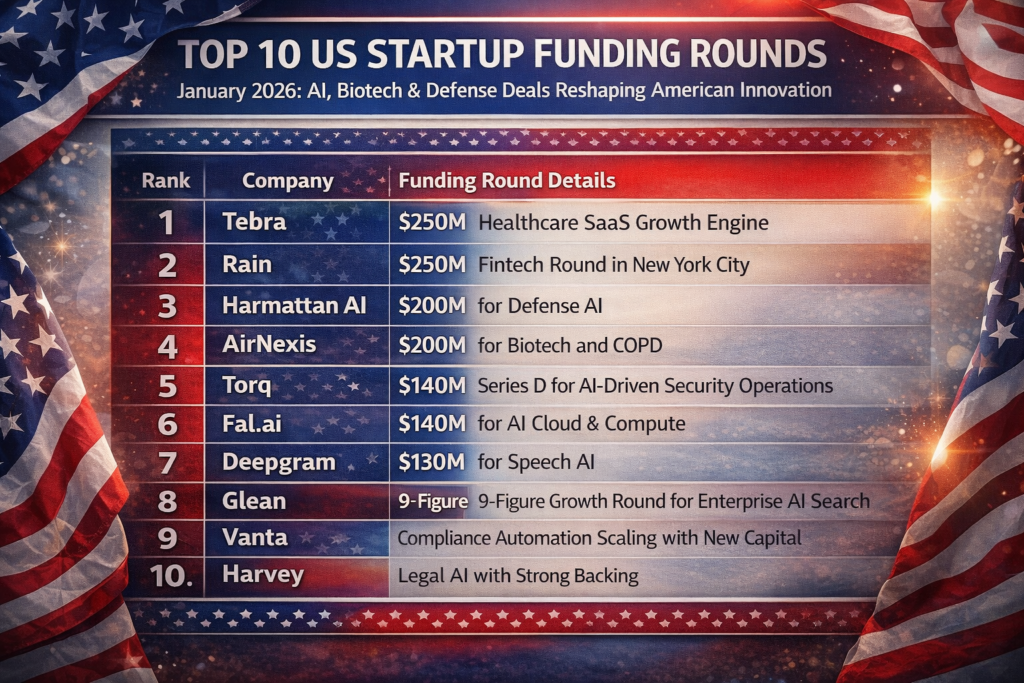
Tebra – $250M Healthcare SaaS Growth Engine
Tebra is a US healthcare software startup that offers an integrated SaaS platform for medical practices, bringing together EMR, billing, and patient engagement tools aimed at smaller and mid-sized providers. The January 2026 $250M growth round, led by Hildred Capital with additional debt financing from J.P. Morgan, is meant to accelerate acquisitions and product expansion across its existing customer base of more than one hundred thousand providers.
This round places Tebra in the top tier of healthcare SaaS companies in terms of capital raised, signaling continued investor appetite for software that can make private practices more efficient in a still‑complex US healthcare landscape. It also reflects a maturing trend in healthcare SaaS where rollups and consolidation are increasingly favored over smaller, fragmented products.
Rain – $250M Fintech Round in New York City
Rain is a US fintech startup centered in New York City that focuses on revenue-based financing for online businesses, such as e‑commerce and SaaS companies, providing non-dilutive capital tied to future revenue. Its $250M Series C round in January 2026 places it among the largest fintech raises this month and underscores New York’s growing importance as a fintech hub relative to the Bay Area.
This deal fits into a larger pattern where investors are backing credit and financing businesses that leverage alternative data and recurring revenue models, giving founders growth capital without forcing equity dilution at every stage. It also highlights that US startup funding January 2026 is not just about AI, but also about financial infrastructure that powers high-velocity, digital-first companies.
Harmattan AI – $200M for Defense AI
Harmattan AI is a US defense-focused AI startup reported to be developing autonomous systems such as drone swarms and battlefield decision-support tools. The company raised a $200M Series B round led by Dassault Aviation, a major aerospace and defense player, positioning Harmattan AI as a key beneficiary of the US “American Dynamism” thesis that emphasizes national security and strategic technology.
This round reflects heightened interest in defense startups as the US Department of Defense pushes initiatives like Replicator, which aims to rapidly deploy thousands of autonomous systems. It signals that in 2026, venture-backed defense AI startups are no longer niche, but central to the US startup narrative.
AirNexis Therapeutics – $200M for Biotech and COPD
AirNexis Therapeutics is a US biotech startup working on therapies for chronic obstructive pulmonary disease (COPD) and potentially other respiratory conditions, with a focus on inhaled or respiratory modalities. Its $200M Series A round, backed by life sciences investors like Frazier Life Sciences and OrbiMed, is a standout large early-stage raise in a sector that is primed for a 2026 rebound.
Reuters reports that the broader biotech sector is poised for a stronger year in 2026 as IPO interest grows again, and AirNexis sits squarely within that trend as a high-profile clinical-stage company. The size of this round suggests investors expect a clear path through Phase 2 trials and into registration-enabling studies in the near term.
Torq – $140M Series D for AI-Driven Security Operations
Torq is a security operations (SecOps) startup that uses workflow automation and AI to help enterprises handle security alerts, reduce noise, and orchestrate responses across tools. In January 2026, Torq raised a $140M Series D round led by Insight Partners, with participation from other late-stage investors, putting it firmly in growth-stage territory.
This raise aligns with a broader surge in cybersecurity funding focused on AI-powered detection and response, as organizations struggle with rising alert volumes and shortage of skilled analysts. For US startup funding January 2026, Torq is one of the key examples of AI being embedded deeply into enterprise security workflows.
Fal.ai – $140M for AI Cloud & Compute
Fal.ai is a US-based AI infrastructure startup that offers a cloud platform optimized for running AI models, effectively acting as a serverless compute or GPU marketplace for developers and enterprises. The company’s approximately $140M Series D round in early 2026 reflects the enormous demand for GPU access and optimized AI runtimes as more companies build on large models.
Infrastructure-focused startups like Fal.ai are part of a “picks and shovels” wave, where investors are backing the underlying platforms that make AI cheaper and faster to deploy across industries. This deal underscores that cloud and infra remain critical segments of the US startup ecosystem despite economic headwinds.
Deepgram – $130M for Speech AI
Deepgram is a US speech AI startup offering APIs for transcription, voice recognition, and audio understanding, used by enterprises for call centers, analytics, and real-time voice applications. The $130M Series C round led by AVP and others in January 2026 adds fuel to its efforts to scale multilingual and domain-specific models.
This raise fits into an ongoing shift where speech and multimodal AI are becoming core components of enterprise platforms, not just add-on features. For January 2026, Deepgram stands out as a specialized AI company that is not a foundation-model lab but still capturing substantial venture dollars.
Glean – 9‑Figure Growth Round for Enterprise AI Search
Glean is a US enterprise AI search startup that allows employees to search across internal tools, documents, and conversations, providing a unified knowledge layer. It reportedly raised a 9‑figure growth round (around $100M or more) in late 2025 or early 2026, contributing to its status as one of the premium late-stage AI companies in the US.
This funding signals strong adoption of AI-powered enterprise search as companies struggle with knowledge fragmentation across SaaS tools. Glean’s position in the January 2026 funding narrative shows how AI is reconfiguring internal productivity and not just customer-facing products.
Vanta – Compliance Automation Scaling with New Capital
Vanta is a US startup offering automated security and compliance checks to help SaaS companies and other businesses achieve certifications like SOC 2 and ISO faster and with less manual effort. Its roughly $70–75M Series C–style funding in the current period supports product expansion and market penetration among small and mid-sized companies that must now meet increasingly strict security requirements.
Vanta’s inclusion in this top-10 list highlights how compliance and trust are now central themes in US startup funding January 2026, especially as AI and data-heavy platforms scale quickly.
Harvey – Legal AI with Strong Backing
Harvey is a US legal AI startup that builds tools for law firms and in-house legal teams to draft and analyze documents using large language models. Backed by notable investors including capital linked to OpenAI, Harvey’s Series B round in the ~$60–65M range cements it as one of the leading legal AI startups in the US.
Legal AI is part of a broader wave of domain-specific AI applications that investors see as particularly defensible due to the combination of specialized data, workflows, and expert users. Harvey’s raise indicates strong confidence in AI for high-value professional services.
| Rank | Startup | Amount Raised | Stage | Key Investors | Sector | HQ / Hub |
|---|---|---|---|---|---|---|
| 1 | Tebra | $250M | Growth | Hildred Capital, JP Morgan (debt) | Healthcare SaaS | Irvine, CA |
| 2 | Rain | $250M | Series C | Undisclosed | Fintech (Revenue Financing) | New York City |
| 3 | Harmattan AI | $200M | Series B | Dassault Aviation | Defense AI | US Defense Hub |
| 4 | AirNexis Therapeutics | $200M | Series A | Frazier, OrbiMed | Biotech (COPD) | US Biotech Cluster |
| 5 | Torq | $140M | Series D | Insight Partners | AI SecOps | US Enterprise Hub |
| 6 | Fal.ai | $140M | Series D | Undisclosed | AI Cloud Infrastructure | San Francisco |
| 7 | Deepgram | $130M | Series C | AVP and others | Speech AI | Bay Area |
| 8 | Glean | $100M+ | Growth | Sequoia, Lightspeed | Enterprise AI Search | Palo Alto |
| 9 | Vanta | $70–75M | Series C | Craft Ventures | Compliance Automation | San Francisco |
| 10 | Harvey | $60–65M | Series B | OpenAI-linked capital | Legal AI | San Francisco |
US startup funding in January 2026 is clearly clustering around AI, healthcare, defense, and fintech, with New York and the Bay Area soaking up most large rounds and signaling a more confident, IPO-aware market than in 2025. For founders, this first wave of capital sets the tone for 2026: deep-tech narratives, real revenue, and category-defining products are what unlock nine‑figure checks.
Taken together, these top 10 US startup funding rounds in January 2026 show that investors are prioritizing mission‑critical sectors—healthcare, biotech, defense, and AI infrastructure—rather than broad, unfocused software plays. The fact that both early clinical-stage biotech like AirNexis and growth-stage SaaS like Tebra and Rain attracted such large rounds suggests that capital is flowing to teams with clear regulatory paths, strong unit economics, and credible exit options.
For the rest of 2026, founders can expect heightened competition for big rounds but better terms if they operate in these priority sectors, anchor themselves in major hubs such as SF or NYC, and demonstrate measurable traction rather than just top‑line user growth.
FAQs: US Startup Funding January 2026
Q1. What is the biggest US startup funding round in January 2026 so far?
The largest disclosed US rounds so far are Tebra’s $250M growth equity raise in healthcare SaaS and Rain’s $250M Series C in NYC fintech, making them joint leaders for the month.
Q2. Which sectors are attracting the most funding in January 2026?
AI and AI infrastructure, healthcare/biotech, defense tech, and fintech are attracting the biggest rounds, with companies like Fal.ai, Deepgram, AirNexis Therapeutics, Harmattan AI, Tebra, and Rain all raising nine‑figure amounts.
Q3. Which US cities are leading startup funding in early 2026?
The San Francisco Bay Area and New York City lead by volume and deal size, with SF dominating AI and infra (Fal.ai, Deepgram, Glean, Vanta, Harvey) and NYC standing out in fintech and legal AI (Rain, Harvey’s client base).
Q4. How is biotech funding looking compared to 2025?
Biotech funding is improving versus 2025, with Reuters noting that the US biotech sector is poised for a 2026 rebound in IPO activity and large private rounds such as AirNexis’s $200M Series A underlining renewed investor confidence.
Q5. What are investors like Andreessen Horowitz focusing on in 2026?
Andreessen Horowitz has raised about $15B in new funds focused on AI, bio, and “American Dynamism” (defense and strategic tech), which aligns directly with the types of startups getting funded in early 2026.
Q6. What should founders do to raise in this environment?
Founders aiming to raise in 2026 should focus on clear sector fit (AI, healthcare, defense, fintech), strong revenue or clinical milestones, and basing operations in or connected to major hubs like SF, NYC, Boston, or Austin to access active investors and strategic partners.
Visit bestartup.us for real-time updates, funding insights, and the latest trends shaping the U.S. Startup Ecosystem 2025.
Frequently Asked Questions
What were the biggest US startup funding rounds in January 2026?
January 2026 saw significant deal activity across AI, biotech, and defence sectors in the US. AI companies continued to capture the largest individual rounds as investors competed for access to frontier AI capabilities. Biotech deals reflecting advanced clinical trial data and AI-drug discovery platforms attracted major institutional investment. Defence tech remained a high-priority category for both government-adjacent venture funds and traditional VCs responding to increased federal procurement spending.
How did AI startup funding perform in January 2026?
AI startup funding in January 2026 maintained the strong momentum of 2025, with enterprise AI, AI agent platforms, and AI-powered vertical software companies all raising at elevated valuations. The distinction between pure AI research companies and applied AI businesses (using AI to deliver specific industry outcomes) became more pronounced in investor selection criteria, with applied AI companies showing stronger revenue metrics that justified continued investor appetite at scale.
What biotech deals closed in the US in January 2026?
US biotech continued its strong performance in January 2026, with deals concentrated in oncology, neuroscience, and AI-assisted drug discovery platforms. Companies with clinical-stage assets and compelling Phase II data commanded premium Series B and C valuations. The intersection of AI and drug discovery — with companies using machine learning to design novel drug candidates and predict clinical outcomes — attracted both traditional biotech investors and AI-focused funds entering the life sciences space.
How are US defence tech startups raising money in early 2026?
US defence tech startups in early 2026 benefited from a combination of government contract awards that de-risked private investment and strong venture interest in dual-use technologies with both commercial and defence applications. Prominent investors including a16z, Founders Fund, and a wave of specialist defence tech funds (Shield Capital, Paladin Capital, Razor’s Edge) maintained active deal pace. Drones, cybersecurity, space surveillance, and AI-powered logistics were leading categories.
What does January 2026 startup funding tell us about the full year?
January is historically a strong indicator of annual venture trends, as investors deploy capital from freshly closed funds and founders who waited out the holiday period bring deals to market. A robust January 2026 suggested continued investor appetite for high-conviction AI, biotech, and deep tech bets, even as the broader venture market remained disciplined about valuations relative to the 2021 peak. The patterns of sector concentration and geographic distribution in January typically persist through the year.
How does US startup funding in January 2026 compare to January 2025?
January 2026 US startup funding showed year-over-year growth compared to January 2025, continuing the recovery trend that began mid-2024. The increase reflected improved LP confidence driven by interest rate reductions, a recovering IPO market that demonstrated exit pathways, and ongoing strong performance from AI investments that validated the thesis for continued deployment. The composition also shifted, with more late-stage capital available to proven companies and early-stage deal counts remaining below 2021 peaks.
Related coverage: US Startup Ecosystem 2025: Month-Wise Funding & Innovation | US Startup Funding Rounds June 2026 | US Leads at Davos 2026: AI, Energy, and Trade Strategy